Min Max Game
You are given a 0-indexed integer array nums whose length is a power of 2.
Apply the following algorithm on nums:
- Let
nbe the length ofnums. Ifn == 1, end the process. Otherwise, create a new 0-indexed integer arraynewNumsof lengthn / 2. - For every even index
iwhere0 <= i < n / 2, assign the value ofnewNums[i]asmin(nums[2 * i], nums[2 * i + 1]). - For every odd index
iwhere0 <= i < n / 2, assign the value ofnewNums[i]asmax(nums[2 * i], nums[2 * i + 1]). - Replace the array
numswithnewNums. - Repeat the entire process starting from step 1.
Return the last number that remains in nums after applying the algorithm.
Example 1:
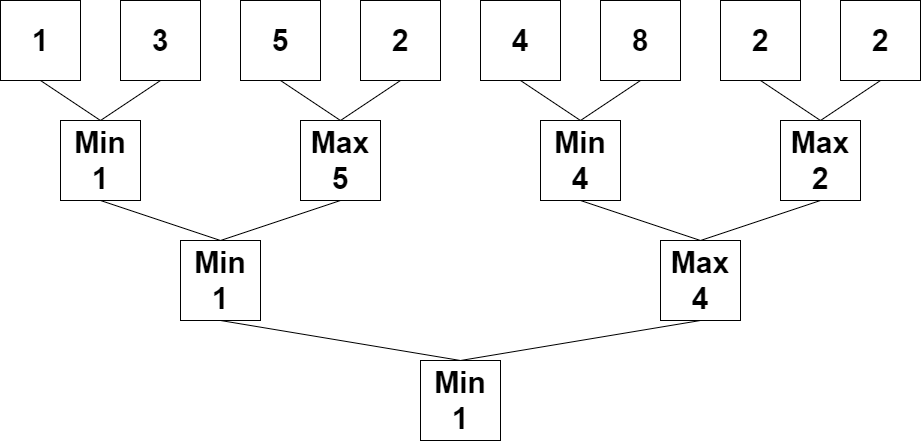
Input: nums = [1,3,5,2,4,8,2,2]
Output: 1
Explanation: The following arrays are the results of applying the algorithm repeatedly.
First: nums = [1,5,4,2]
Second: nums = [1,4]
Third: nums = [1]
1 is the last remaining number, so we return 1.
Example 2:
Input: nums = [3]
Output: 3
Explanation: 3 is already the last remaining number, so we return 3.
Constraints:
1 <= nums.length <= 10241 <= nums[i] <= 109nums.lengthis a power of2.
class Solution:
    def minMax(self, nums, i, j, minm):
        if j == i + 1:
            return nums[i]
        mid = (i + j) // 2
        a = self.minMax(nums, i, mid, True)
        b = self.minMax(nums, mid, j, False)
        if minm:
            return min(a, b)
        return max(a, b)

    def minMaxGame(self, nums: List[int]) -> int:
        n = len(nums)
        return self.minMax(nums, 0, n, True)
Comments
Post a Comment